Fuel Router vs. Mudflap: Which One Actually Saves Fleets More on Diesel?
If you run a small or mid-size trucking fleet and you've spent any time looking for ways to cut fuel costs, you've probably come across both Mudflap and Fuel Router. They show up in the same searches. They both talk about saving money on diesel. They both have apps drivers actually use.
And they get compared all the time.
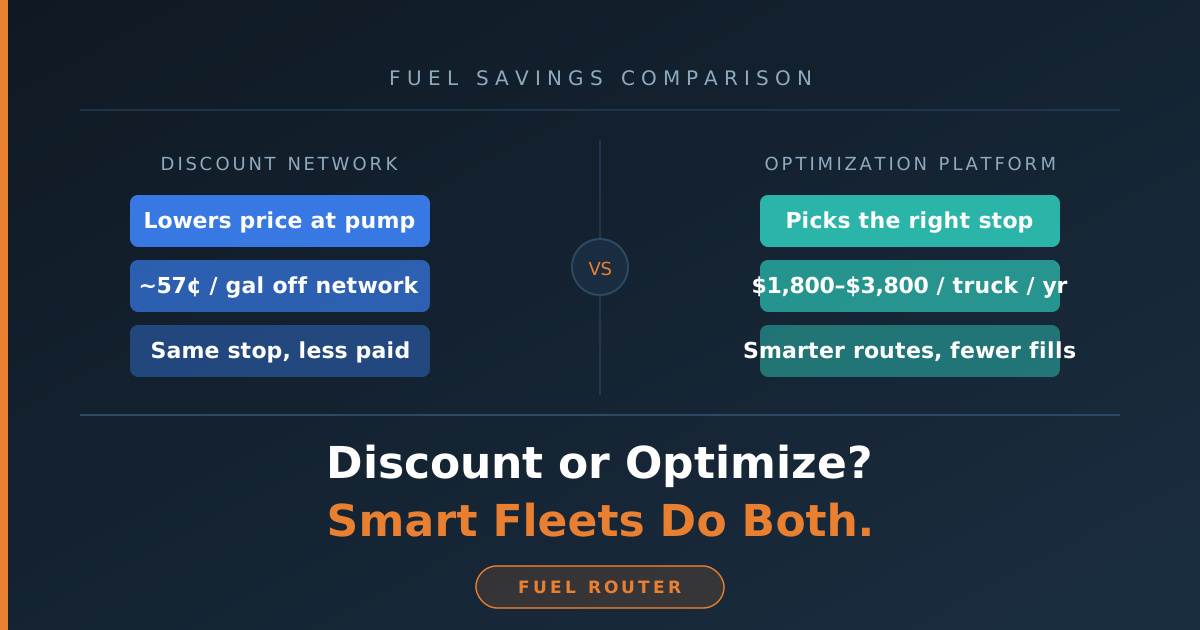
The thing is, they aren't really the same product. Mudflap is a discount network. Fuel Router is an optimization platform. Those are two different jobs, and the right answer for your fleet depends on which problem is actually costing you more money. This post breaks down what each one does, where they overlap, and how to decide which one (or both) belongs in your stack.
Quick Takeaways
- Mudflap is a fuel discount app. It gets you a lower price at participating truck stops, averaging around 57 cents per gallon off at network locations.
- Fuel Router is a fuel optimization platform. It tells your drivers which stops to use and how much to buy based on price minus state tax, route, and tank level.
- They are not mutually exclusive. The biggest fleets often use a discount source AND an optimizer, because they solve different problems.
- For most 5 to 50 truck fleets, fuel optimization captures larger annual savings than discounts alone, because route choice has more leverage than per-gallon pricing.
What Mudflap Actually Does
Mudflap is a fuel discount marketplace. The app connects drivers to a network of around 2,800 truck stops where Mudflap has negotiated a discounted price. When a driver pulls in, they open the app, select the location, and generate a one-time payment code that the cashier punches in at the pump. The driver pays Mudflap, Mudflap pays the truck stop, and the savings show up as a lower posted price.
It's a clean model. There's no monthly fee, no credit check, no hardware to install. Drivers like it because it's frictionless and the savings are immediate.
What Mudflap is good at:
- Getting you a better price at a network truck stop than the pump price
- Replacing or supplementing a traditional fuel card program
- Working for owner-operators and small fleets that don't want a contract
- Providing free truck-safe GPS routing as a bonus feature
What Mudflap does not do:
- Tell you which stop along your route is the best one to use
- Account for state diesel tax differentials when picking stops
- Plan how many gallons to buy at each stop based on tank level and the next cheaper stop ahead
- Cover non-network stations beyond a small per-gallon discount
In other words, Mudflap answers the question "how do I pay less at this truck stop?" It does not answer the question "which truck stop should I be at?"
What Fuel Router Actually Does
Fuel Router is a fuel stop optimization platform. Drivers (or dispatchers) put in the trip, and Fuel Router returns a fueling plan: which stops to hit, how many gallons to buy at each one, and what the projected cost is for the trip. The optimization engine accounts for posted price, state diesel tax, distance off-route, tank capacity, and the price of the next stops downroute, so drivers aren't filling up at the wrong place just because it's familiar.
What Fuel Router is good at:
- Picking the cheapest stop on your actual route, not the cheapest stop in a network
- Doing the state tax math for you (a stop in Arizona at the same posted price as Utah is meaningfully cheaper because of the tax differential)
- Splitting fills across multiple stops when that beats one big fill
- Working with any fuel card or payment method, including Mudflap
What Fuel Router does not do:
- Negotiate discounts directly with truck stops
- Replace your fuel card or payment rail
The simplest way to think about it: Mudflap changes the price of a stop. Fuel Router changes which stop you use.
The Math on Why Route Choice Beats Per-Gallon Discounts
Here's where this gets concrete. A truck running 110,000 miles a year at 6.5 MPG burns about 16,900 gallons of diesel.
If a driver gets 57 cents per gallon off at every fill via Mudflap, that is roughly $9,633 a year in savings. That number is real and it adds up across a fleet. But it also assumes the driver is fueling at the right truck stops to begin with.
Now consider fuel optimization. The price spread between the cheapest and the most expensive stop along a typical OTR route can easily be 50 to 80 cents per gallon. State tax differentials alone can swing 10 to 20 cents. A driver who fills up in a high-tax state when a low-tax stop is 90 miles down the road is leaving 15 to 25 cents per gallon on the table on that fill, before any discount math even starts.
Across a year, picking the right stops typically saves another 8 to 14 cents per gallon, fleet-wide, on top of whatever discounts the driver is already getting. On 16,900 gallons, that is another $1,350 to $2,366 per truck per year. For a 20-truck fleet, that is $27,000 to $47,000 in savings that no discount program will catch, because the discount doesn't tell you where to be.
The point is not that one number is bigger than the other. The point is they are stacking different rebates on different decisions, so they don't cancel out.
Where Mudflap and Fuel Router Overlap
The honest overlap is in the driver app experience. Both products live on a phone, both want to be the screen the driver opens before they pull off the highway. If a fleet is choosing only one app for drivers to use, it can feel like a coin flip.
Both also touch fuel cost in some way. Both have free routing features. Both work for small and mid-size fleets without an enterprise contract.
The difference is what happens when the driver opens the app:
- Mudflap shows you "here are the cheapest network stops near you and what you'll pay at each."
- Fuel Router shows you "given your trip, here's the exact stop to use, here's how many gallons to buy, and here's why this beats the alternative."
One is a marketplace. One is a planner. Fleets that confuse the two end up either over-paying for the wrong stop (Mudflap without optimization) or under-using their discount sources (Fuel Router without a discount card behind it).
When Mudflap Is the Right Pick on Its Own
Mudflap by itself makes sense if:
- You are an owner-operator or run 1 to 4 trucks
- Your routes are short or repeatable enough that drivers already know where to fuel
- You don't have a fuel card today and you want one with no monthly fee
- Your priority is per-gallon discount, not route-level optimization
- You want zero implementation lift
For this profile, Mudflap is a great fit and there is not a strong argument to add anything else.
When Fuel Router Is the Right Pick on Its Own
Fuel Router by itself makes sense if:
- You run 5 or more trucks
- Drivers cover multi-state routes where state tax math matters
- You already have a fuel card you like and you don't want to switch payment rails
- You want the savings to come from smarter routing, not a different cashier process
- You want fleet-wide visibility into what each truck is actually spending and why
For this profile, Fuel Router does the heavier lifting because route choice scales with fleet size in a way that per-gallon discounts don't.
When You Should Use Both
This is the answer that nobody markets, but it is the one that delivers the most savings for fleets in the 10 to 50 truck range.
Use Fuel Router to decide which stop to use and how many gallons to buy. Use Mudflap (or any other discount source) to pay for the fuel at that stop. The optimization layer picks the right stop. The discount layer reduces what you pay when you get there. They stack cleanly because they are operating on different variables.
Fleets that do this typically see total fuel savings in the $1,800 to $3,800 per truck per year range, which is meaningfully higher than either tool produces alone.
The Bottom Line Mudflap and Fuel Router are not actually competitors. They are complementary. Mudflap discounts the price at the cashier. Fuel Router decides which cashier you should be standing in front of. If your fleet is bigger than a few trucks and your routes cross state lines, the leverage from optimization is bigger than the leverage from discounts, but the smartest fleets use both.
The wrong question is "Mudflap or Fuel Router?" The right question is "which one is currently leaving more money on the table for my fleet?"
See What Optimization Could Save Your Fleet
Most fleets we talk to are surprised by how much money they leave on the table from route-level decisions, even when they already have a discount program in place. We can run the numbers on your actual routes and show you what optimization would add to whatever you're already saving.
Get a free fuel savings analysis →
Related Reading
- Fuel Router vs. Manual Fuel Planning: What's the Real ROI?
- Fleet Fuel Tracking Without Spreadsheets
- Speed Management and Fuel Savings: The Hidden 7%
How Much Are You Overpaying for Diesel?
Enter your fleet size and see your estimated annual savings in seconds — free, no email required.
Get Your Free Savings Estimate →