McLeod LoadMaster Doesn't Optimize Fuel. Here's What Does.
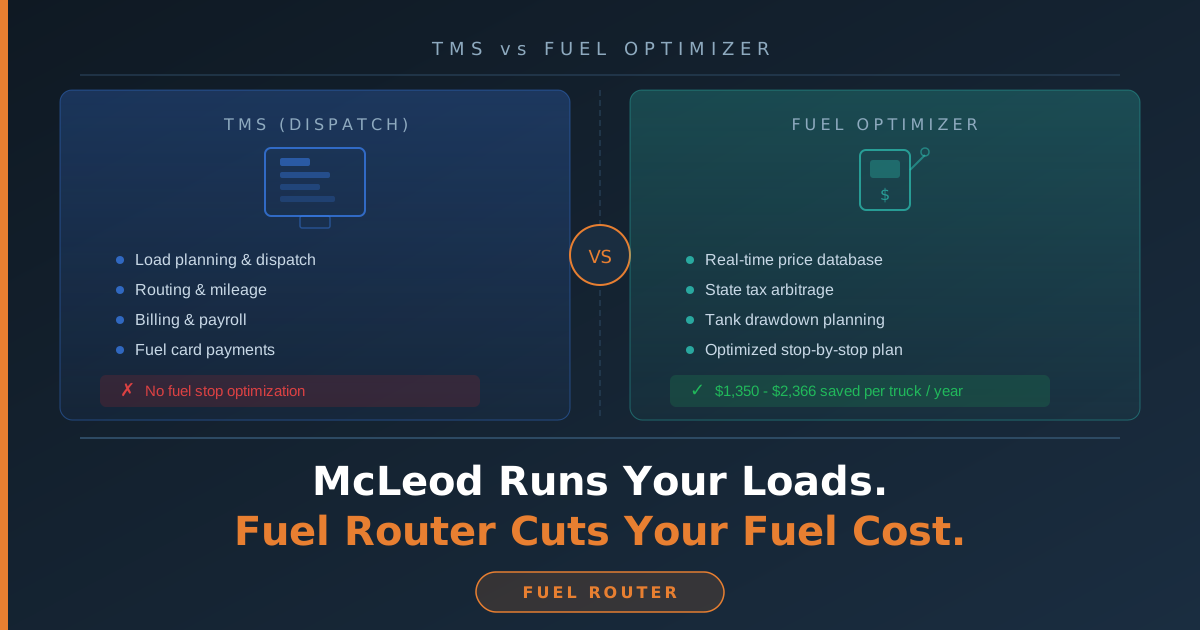
McLeod LoadMaster is the backbone TMS for thousands of trucking carriers. It handles dispatch, load planning, billing, driver workflow, and equipment tracking. It does all of those things well. But there is one thing it does not do: tell your drivers where to fuel.
That surprises a lot of fleet owners. They assume that a system managing every other part of their operation must also be managing the single biggest line item on the P&L. Fuel accounts for 60% or more of operating expenses for heavy-duty fleets. Yet McLeod ships zero native fuel optimization. No price database. No stop-by-stop planning. No state tax arbitrage. No tank drawdown logic.
If you run your fleet on McLeod and you want optimized fueling, you need a separate tool. This post explains what McLeod actually covers, what it doesn't, and why a growing number of McLeod fleets are choosing Fuel Router to fill that gap.
What McLeod LoadMaster Actually Handles
LoadMaster is a carrier TMS. It is designed to manage everything from the time a load is booked to the time an invoice goes out. The feature set includes:
- Dispatch and load planning with driver assignment and trip sheets
- Routing and mileage through Google Maps and PC*Miler integrations
- Driver workflow and trip management including the Driver Choice features added in version 19.1
- Equipment tracking, billing, payroll, and document management
- Fuel card payment integrations with Comdata, EFS, and Relay Payments
That last bullet is where the confusion starts. McLeod connects to fuel card payment systems so transactions flow into your accounting. But processing a fuel card payment is not the same as optimizing where and how much your driver buys. A payment integration tells you what was spent. An optimizer tells you what should have been spent.
Why McLeod Doesn't Build Fuel Optimization In-House
McLeod's business model is to be the central dispatch and operations platform, then connect to best-of-breed tools for specialized functions. This is the same reason McLeod doesn't build its own ELD hardware or its own load board. Specialized tools require specialized data. For fuel optimization, that means a continuously refreshed nationwide price database, state-by-state tax tables, tank capacity modeling, and stop-scoring algorithms that weigh price against distance off-route.
Instead of building all of that, McLeod maintains a certified partner ecosystem. When a McLeod customer needs fuel optimization, McLeod sends dispatch data and trip details to one of these third-party tools:
| Tool | Type | Typical Customer | |---|---|---| | ProMiles FuelMizer | Legacy fuel purchase optimizer | Large carriers, 200+ trucks | | IDSC Expert Fuel (Trimble) | Enterprise fuel optimization ASP | Enterprise fleets on Trimble stack | | Manhattan Fuel & Route | Door-to-door routing + fuel engine | Large enterprise with Manhattan WMS | | Breakthrough Fuel | Fuel cost management platform | Enterprise shippers and carriers |
Every one of these tools was built for enterprise. They require seat-license contracts, dedicated IT resources for integration, and per-truck-per-month pricing that makes the math tough for a 15-truck fleet. If your operation runs 200 trucks and has a full-time IT team, these tools work. If you run 10 to 50 trucks and your "IT department" is whoever's phone isn't ringing, they don't.
The Gap McLeod Fleets Actually Feel
Talk to a fleet manager running McLeod without a fuel optimizer and you hear the same three problems:
1. Drivers pick stops based on habit, not price. Without optimization, drivers fuel where they always fuel. That might be a familiar Love's or a Pilot with clean showers. It is almost never the cheapest option on the route when you factor in state tax differentials and posted price variation.
2. Nobody is doing the state tax math. Diesel tax varies by 20 cents or more between neighboring states. A fill-up in Pennsylvania (78.3 cents/gallon tax) versus Ohio (47 cents/gallon tax) on the same corridor is a meaningful difference. McLeod doesn't calculate this. Most dispatchers don't either. The money just leaks.
3. Fuel spend shows up in reports but nobody can explain the variance. McLeod tracks what was spent. It does not tell you what should have been spent if every stop had been optimized. So fleet owners see the total, know it's too high, and have no way to quantify the opportunity.
These aren't edge cases. They are the default for any McLeod fleet that hasn't bolted on a fuel optimizer. And because the legacy options are expensive and heavy to deploy, most sub-50-truck fleets just live with the waste.
How Fuel Router Fills the McLeod Fuel Gap
Fuel Router is a fuel stop optimization platform built for the fleets that legacy enterprise tools left behind. It runs alongside any TMS, including McLeod, without requiring a certified integration to get started.
Here is how it works for a McLeod fleet:
Step 1: The dispatcher enters the trip (origin, destination, current fuel level). This takes about 30 seconds.
Step 2: Fuel Router returns a fueling plan. Which stops to hit, how many gallons at each one, and the projected trip fuel cost. The engine factors in real-time posted prices, state diesel tax, distance off-route, and tank capacity.
Step 3: The dispatcher pushes the plan to the driver. The driver gets the stops on their phone. No training, no app to learn, no hardware.
Step 4: After the trip, fleet managers see actual versus optimized cost in the dashboard. Over time, this data shows exactly how much the fleet is saving and where the remaining opportunities are.
The McLeod TMS stays in place. Dispatch still happens in LoadMaster. Billing still happens in LoadMaster. Fuel Router handles only the fuel decision layer that McLeod was never designed to handle.
Fuel Router vs. the Legacy McLeod Fuel Optimizer Stack
If you are a McLeod fleet currently paying for ProMiles or IDSC, here is how Fuel Router compares:
| | ProMiles / IDSC | Fuel Router | |---|---|---| | Built for | 200+ truck enterprise fleets | 5 to 100 truck fleets | | Pricing | Per-seat enterprise license + implementation fees | Monthly subscription, no implementation fee | | Price refresh | Typically once daily | Real-time | | Driver experience | Desktop or legacy mobile | Modern phone app, no training needed | | Time to go live | Weeks to months (IT integration required) | Same day | | Requires TMS integration | Yes | No (works alongside any TMS) | | State tax optimization | Yes | Yes | | Tank drawdown planning | Yes | Yes |
The core optimization logic, picking the cheapest stop on the route accounting for tax and distance, is the same job. The difference is packaging. Legacy tools assume you have an IT team, a six-figure software budget, and months to implement. Fuel Router assumes you want to start saving this week.
What This Means in Dollars
A truck running 110,000 miles per year at 6.5 MPG burns roughly 16,900 gallons. The price spread between the cheapest and most expensive stops on a typical OTR corridor is 50 to 80 cents per gallon. State tax differentials alone swing 10 to 20 cents.
Most fleets without optimization leave 8 to 14 cents per gallon on the table across their fuel purchases. On 16,900 gallons, that is $1,350 to $2,366 per truck per year.
For a 20-truck McLeod fleet, that adds up to $27,000 to $47,000 in annual savings that the TMS will never capture on its own. Pair those savings with a fuel card discount and the per-truck number climbs higher.
That is real margin sitting inside a problem McLeod was never designed to solve.
Getting Started Without Waiting on IT
The biggest objection we hear from McLeod fleets is "we'd need IT to approve an integration." That is true for the legacy tools. It is not true for Fuel Router.
Fuel Router runs as a standalone layer. Drivers receive optimized stops on their phones. Dispatchers reconcile in McLeod the same way they handle fuel today. There is no data feed to configure on day one, no API key to provision, no certified-partner approval process to wait on.
If your IT team later wants a deeper connection, McLeod's partner ecosystem supports it and we follow the same data spec the existing fuel optimizers use. But you do not need to wait for that to start saving.
The Bottom Line McLeod LoadMaster is a great TMS. It is not a fuel optimizer. When McLeod fleets need fuel optimization, they have historically been pushed toward enterprise tools built for the largest carriers in the country. Fuel Router is the modern alternative: same core optimization, built for the fleets that actually need the savings most, live in a day instead of a quarter.
See What Your McLeod Fleet Is Leaving on the Table
We can run the numbers on your actual routes and show you what optimized fueling would save, no integration required. Most fleets are surprised by the size of the gap.
Get a free fuel savings analysis →
Related Reading
- Fuel Router vs. Mudflap: Which One Actually Saves Fleets More on Diesel?
- Fuel Router vs. Manual Fuel Planning: What's the Real ROI?
- Best Fuel Optimization Software for Fleets [2026 Comparison]
How Much Are You Overpaying for Diesel?
Enter your fleet size and see your estimated annual savings in seconds — free, no email required.
Get Your Free Savings Estimate →